Pinholes Issue and Core Causes in Acrylic Paint Manufacturing
Water-based acrylic paint production is one of the most dynamic and innovative fields of the modern chemical industry. Environmental regulations, the limitation of volatile organic compound (VOC) emissions, and sustainability targets have driven paint manufacturers from solvent-based systems to water-based systems. However, this transition has also brought new physicochemical challenges in formulation architecture and production processes. The inherently high surface tension of water-based systems necessitates the intensive use of various surfactants, such as wetting agents, dispersants, and emulsifiers. This makes foam formation during production—especially in high-speed dispersion stages—an unavoidable engineering problem. In this article, we will examine the fundamental mechanisms of the pinhole issue, which is frequently encountered in acrylic paint production and leads to severe quality losses on the final film surface, and discuss from a technical perspective how this problem can be permanently solved through the selection of appropriate liquid defoamer/antifoam technologies.
High-Speed Dispersion and Micro-Foam Formation Dynamics
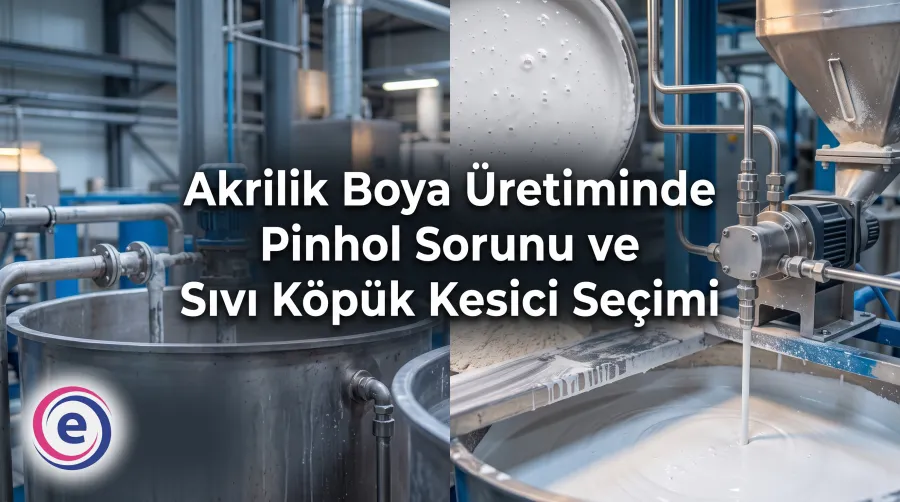
The process of dispersing pigments and extenders into the liquid phase, which is one of the most critical stages of acrylic paint production, is generally carried out using Cowles-type high-speed dissolvers or bead mills. The high shear forces applied during this stage break down particle agglomerates to ensure a homogeneous dispersion while simultaneously causing high air entrainment into the system. Surfactants present in water-based formulations rapidly migrate to the liquid-air interface, forming a protective film layer (lamella) around the entrapped air bubbles. Stabilized by the Gibbs-Marangoni effect and electrostatic repulsion forces, these bubbles persist in the system in two distinct forms: macro-foam and micro-foam.
While macro-foams generally tend to rise rapidly to the surface and burst, micro-foams with diameters ranging from 10 to 100 micrometers remain trapped within the paint matrix. In acrylic systems where viscosity is high, the rising velocity of micro-foams to the surface is quite low according to Stokes' Law. This constitutes the basis for physical defects that occur during the drying of the applied paint film. With the paint raw materials portfolio we offer as Ekvator Kimya, it is possible to overcome such surfactant stabilization problems at the formulation stage.
Filmmogenic Mechanism of the Pinhole Defect
A pinhole is a critical surface anomaly that occurs during the curing and drying (coalescence) process of the applied wet paint film. After the paint film is applied to the substrate, water and cosolvents in the formulation begin to evaporate. This evaporation process causes the viscosity of the film to increase logarithmically and its fluidity (leveling ability) to decrease rapidly. Micro-foams entrapped in the system slowly move toward the surface during drying.
However, when the foam reaches the surface and the thin lamella layer covering it bursts, the paint film has generally reached a viscosity high enough to lose its self-leveling capacity. The microscopic void left by the burst bubble cannot be filled by the surrounding polymer chains and solidifies as an open crater. Consequently, microscopic structures resembling needle holes are formed. This defect not only creates an aesthetic problem but also weakens the protective barrier properties of the paint film, rendering the substrate vulnerable to moisture, corrosion, and chemical influences. Especially in industrial wood coatings, anti-corrosive primers, and high-gloss topcoat acrylic paints, the pinhole defect is a direct cause of product rejection in quality control.
Liquid Defoamer Technologies and Operating Principles
The most effective way to control the foaming problem and prevent pinhole defects is to integrate appropriate liquid defoaming agents into the formulation that do not disrupt the rheological structure. Defoamers are chemical additives that thermodynamically destabilize the foam lamella and cause bubbles to coalesce and burst. For a defoamer to be effective in the system, it must simultaneously satisfy two fundamental physical conditions:
- Entry Coefficient (E > 0): The ability of the defoamer droplet to exit the water-based phase and enter the foam skin (lamella).
- Spreading Coefficient (S > 0): The ability of the defoamer droplet that has entered the lamella to displace surfactants and spread over a large area at the interface.
This new hydrophobic film layer formed by the defoamer has a much lower cohesive strength compared to the original foam skin. Due to the reversal of the Marangoni effect and the influence of capillary forces, the film layer progressively thins and ultimately ruptures, causing the micro-bubble to burst. Modern industrial defoamers typically consist of a synergistic combination of a carrier liquid (mineral oil, silicone oil, or polyether), hydrophobic particles (treated silica, metallic soaps, polyurea derivatives), and specific emulsifiers that balance compatibility with the system. Ekvator Kimya's extensive product list includes high-performance and calibrated liquid agents capable of adapting to the rheology of all types of acrylic formulations.
Correct Defoamer Selection Criteria for Acrylic Systems
Selecting the correct liquid defoamer for acrylic systems is a rigorous optimization process for R&D and Quality Control managers. The fundamental challenge in the selection process is establishing the delicate thermodynamic balance between "compatibility" and "efficiency." If the defoamer is highly compatible with the system (too hydrophilic), it will struggle to enter the foam lamella and its efficiency will remain very low. Conversely, if it is excessively incompatible with the system (too hydrophobic), defoaming performance may be maximized, but it will cause secondary surface defects on the film, such as macro-craters, fisheyes, or an orange peel appearance.
There are three main classes of defoamers commonly used in water-based acrylic paints: mineral oil-based, silicone-based (polysiloxanes), and polymeric defoamers. Mineral oil-based defoamers are generally preferred in matte and semi-matte interior/exterior architectural paints due to cost advantages and high PVC (Pigment Volume Concentration) tolerance. However, in systems requiring excellent surface smoothness, such as high-gloss acrylic topcoats, industrial floor coatings, and clear wood varnishes, organically modified polysiloxane (polyether siloxane)-based defoamers are indispensable. These molecules accelerate the transport of micro-foams to the surface by lowering the surface tension locally and extremely rapidly. For broader information on related formulation strategies, you can also reference our article titled Use of Defoamers in Water-Based Paints.
Dosage and Process Optimization in Production Stages: Grind and Let-Down
In addition to the chemical structure of the defoamer, the stage of the production process and the form in which it is added directly affect final performance. Paint manufacturing typically consists of two main stages: Grind and Let-down. The grind phase is where high shear forces are applied, and pigments and extenders are dispersed. The defoamer used in this stage must be resistant to high mechanical stress (shear) and prevent heavy air entrainment into the system from the outset. Strong defoamers containing 100% active matter that are partially incompatible with the system yet sufficiently micronized and homogeneously dispersed at high speeds (e.g., mineral oils containing hydrophobic silica or concentrated silicones) are generally preferred at this stage.
The let-down phase is the sensitive phase where acrylic polymer emulsions, rheology modifiers, and color pastes are added under much lower shear forces. Defoamers subsequently added to the formulation at this stage must be much easier to mix, typically in an aqueous emulsion form and possessing high compatibility with the system. Otherwise, low-shear mixing will be insufficient to break down pure defoamer droplets into a sufficiently small size, creating localized hydrophobic areas (craters) in the film. As an industry standard, the best results are obtained by integrating the defoamer dosage (generally between 0.1% and 0.5% of the total formulation weight) into the system by splitting it between both stages (e.g., 60% in the grind phase, 40% in the let-down phase).
Test Methodologies for Quality Control and R&D Laboratories
Standardized test methodologies are vital for evaluating defoamer performance and eliminating pinhole risks in R&D laboratories. Density/specific gravity measurement is the first step required for macro-foam control; the difference between the calculated theoretical density of the formulation and the practical density measured with a pycnometer post-production yields the percentage of total air entrapped in the system.
However, more sensitive application simulations are needed to detect the invisible micro-foams that cause the pinhole issue. Draw-down tests applied at the micron level on black/white Leneta cards or transparent glass panels are ideal for observing the coalescence behavior of the wet film during drying. Furthermore, sponge roller application (roller test) or air-spray applications test application-induced foaming under actual field conditions. Storage stability test is also a critical parameter; while a defoamer may work flawlessly on day one, it may lose its efficacy weeks later due to the diffusion of the carrier oil into the polymer matrix. To anticipate this condition, samples should be kept in ovens at 40-50°C for 4 weeks within the scope of accelerated aging tests, and performance losses must be regularly reported.
Conclusion: Permanent Surface Perfection with Ekvator Kimya
In conclusion, the pinhole issue encountered in acrylic paint manufacturing is a technical defect that fundamentally stems from complex surface tension dynamics, surfactant interactions, and micro-foam stabilization, yet can be completely resolved through the integration of appropriate chemical agents matching the rheology. Understanding the physicochemical mechanisms of liquid defoamer technologies correctly, optimizing the compatibility-efficiency balance specifically for the formulation, and standardizing dosage strategies in production processes are the only ways to achieve high-quality, smooth, and weather-resistant paint films.
As Ekvator Kimya, we offer tailor-made solutions to the technical needs of the paint industry with our deep expertise in industrial chemistry, international-standard raw material quality, and innovative R&D approach. We are by your side with our expert chemical engineering staff to find permanent and sustainable solutions to the micro-foaming, pinhole, and surface defect problems you experience in your formulations, accelerate your R&D optimization processes, and ensure correct raw material supply. You can immediately contact our technical team to review specific technical data sheets (TDS) regarding our product portfolio, request samples for industrial production trials, and initiate the direct technical support process. Secure your production lines and take a step ahead in market competition.