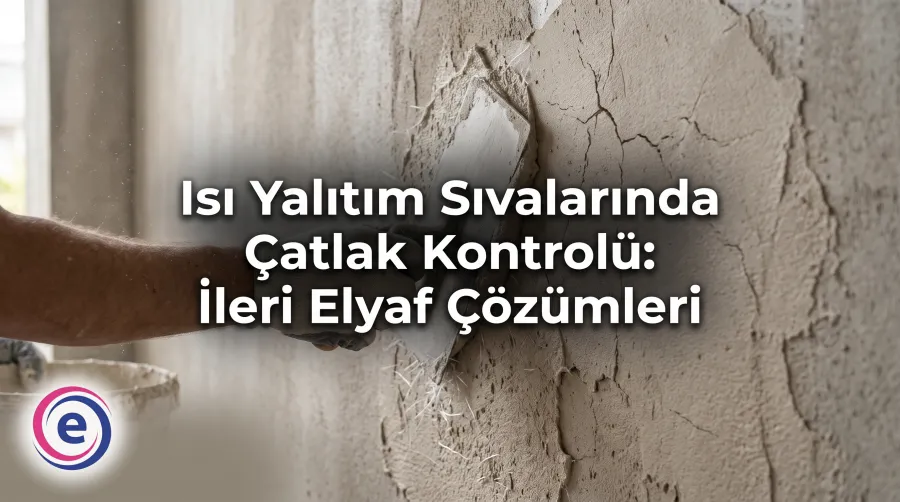
Crack Problem in External Thermal Insulation Composite Systems (ETICS) and Its Industrial Significance
External Thermal Insulation Composite Systems (ETICS) have become the industry standard for increasing the energy efficiency of modern buildings, reducing the carbon footprint, and ensuring indoor thermal comfort. However, the long-term success of these composite systems depends on the integrity of the thin-layer cement-based plaster matrix applied over insulation boards (EPS, XPS, Rockwool) and its resistance to environmental stresses. Because thermal insulation renders form the outermost shell of a structure, they are directly exposed to severe dynamic stress factors such as solar radiation, sudden temperature changes (thermal shocks), wind loads, freeze-thaw cycles, and structural movements. These continuously variable stresses lay the groundwork for the formation of micro-shrinkage cracks in the traditional cement matrix over time.
Micro-shrinkage cracks (hairline cracks with a width between 0.1 mm and 0.3 mm) may initially be perceived merely as an aesthetic problem or surface defect. From a building physics perspective, however, these cracks cause rainwater to seep into the inner layers of the system via the capillary water absorption mechanism. Water seeping behind the insulation board or into the plaster matrix freezes and expands during winter months, and the internal pressure generated by the ice leads to the detachment of the plaster from the insulation board (delamination). This issue is among the primary quality complaints and warranty claims returned from construction sites to manufacturers. For R&D departments and production managers, the most scientific and cost-effective way to overcome this problem is to integrate the correct construction raw materials into plaster formulations and increase the toughness of the matrix, particularly by utilizing advanced fiber reinforcement technologies. In this technical article prepared by Ekvator Kimya, we deeply examine the mechanical dynamics of cellulose, glass, and polypropylene (PP) fiber solutions used in formulations to maximize crack control in thermal insulation plasters.
Crack Formation Mechanisms and Stress Factors in Thermal Insulation Plasters
The formation of cracks in cement-based mortars and thin-layer plasters is fundamentally based on different physicochemical mechanisms occurring in the fresh mortar phase and the hardened mortar phase. When examining shrinkage problems in cement-based plasters, it is observed that the biggest problem encountered in the fresh mortar phase is plastic shrinkage. In exterior applications, the UV effect of the sun, high ambient temperature, and wind speed dramatically increase the evaporation rate of free water on the mortar surface. When the evaporation rate exceeds the rate of bleeding occurring from the inner parts of the mortar toward the surface, negative capillary pressure forms on the surface. Because the cement matrix has not yet reached sufficient tensile strength and structural rigidity at this early stage, the resulting shrinkage stresses rupture the matrix and cause plastic shrinkage cracks.
In the hardened mortar phase, drying shrinkage and thermal dilation differences come into play. Drying shrinkage is the tendency of the matrix to shrink volumetrically as hydration reactions are completed and water in the gel pores evaporates. A more critical situation in ETICS systems is interface stresses. There are massive chasms in terms of modulus of elasticity and coefficient of thermal expansion between the insulation board (e.g., EPS) and the mineral-based plaster layer. When a facade heated under the sun encounters a suddenly falling cold rain, the insulation board underneath reacts differently while the plaster layer wants to shrink rapidly. Although the compressive strengths of traditional cement-based plasters are quite high (e.g., 10-15 MPa), their tensile and flexural strengths (generally 2-4 MPa) are relatively low. This brittle structure cannot absorb thermal stresses, and because the resulting micro-stresses cannot be dissipated, they turn into macro cracks. The most effective way to control these mechanisms during the formulation stage is fiber reinforcement, which imparts a three-dimensional energy-dissipation network to the mortar matrix at the micro scale.
Three-Dimensional Reinforcement in Crack Control: The Working Principle of Fiber Technology
When added into dry mix or wet mortar, fibers distribute homogeneously within the matrix, forming a randomly oriented, isotropic, and three-dimensional micro-reinforcement network. The primary function of this network is to prevent crack initiation by countering the micro-stresses forming within the mortar, and if cracks have initiated, to stop their propagation by distributing stress concentrations at the crack tips (crack-bridging effect). The performance of a fiber in cementitious systems is directly dependent on the chemical structure of the fiber, aspect ratio, tensile strength, modulus of elasticity, and its interfacial bond with the cement paste (Interfacial Transition Zone interaction). While the reinforcing mesh (glass fiber reinforcement net) provides macro-scale reinforcement, micro-fibers added into the mortar strengthen the internal structure of the matrix, alleviating the load on the mesh and creating a complete composite synergy.
Advanced Fiber Solutions: The Role of Cellulose, Glass, and Polypropylene in Formulation
1. Cellulose Fibers: Rheology Optimization and Fresh Mortar Performance
Cellulose fibers stand out as a versatile additive in the construction chemicals sector thanks to their natural polymeric structures (beta 1-4 linked D-glucose chains). The use of cellulose fiber in thermal insulation plasters not only provides physical crack control but also radically improves the workability, consistency, and rheological profile of the mortar. The hydrophilic (water-attracting) structure, capillary-voided tubular form, and high specific surface area of cellulose fibers enable them to retain the free water within the mortar like a sponge. While this water retention capacity ensures that the hydration process of the cement proceeds more healthily and for a longer duration, it minimizes plastic shrinkage cracks by preventing rapid evaporation.
Additionally, cellulose fibers establish a three-dimensional, flexible skeletal structure within the matrix, extraordinarily increasing the anti-sagging resistance of the mortar on vertical surfaces. In terms of pumpability and ease of application with a trowel, the pseudo-plastic (shear thinning) and thixotropic behavior imparted to the formulation by cellulose fibers is a major advantage. When the mason strikes the trowel, the mortar decreases in viscosity and spreads easily; when the trowel is withdrawn, it suddenly recovers and stops flowing. By extending the open time, it provides critical flexibility to plasterers, especially during hot summer months. The length-to-diameter ratio and purity degree of the cellulose fiber are the fundamental formulation parameters that determine its synergy with polymers used in ETICS systems (e.g., redispersible polymer powders - RDP).
2. Glass Fibers: Superior Tensile Strength and Alkali Resistance (AR Glass)
Glass fibers are an ideal solution for increasing mechanical resistance and toughness in the hardened plaster matrix with their inorganic silicate structures and exceptionally high tensile strengths (generally in the range of 1500 - 1700 MPa). However, there is a very critical chemical reality that formulators must pay attention to here: The cement matrix creates a highly alkaline environment (pH 12.5 - 13) due to calcium hydroxide released as a result of hydration reactions. Traditional E-Glass fibers undergo corrosion in this alkaline environment over time, losing their silica networks and strengths. Therefore, Alkali Resistant (AR) glass fibers must definitely be used in cement-based thermal insulation plasters.
The high rate of zirconium dioxide (ZrO2 - generally 16% or more) present in the production formulation of AR glass fibers acts as a chemical shield on the fiber surface, providing superior and permanent resistance against alkali attacks. The high modulus of elasticity of glass fibers (approximately 72 GPa) is higher than that of the cement matrix; this ensures that load transfer is from the matrix to the fiber. This property seriously increases the impact resistance of the plaster layer. Especially in ETICS systems used on ground floors, parking garage entrances, or public areas open to mechanical impacts, glass fiber reinforcement is an indispensable safety element. For the homogeneous distribution of glass fibers within the mortar during the production phase, selecting products that have undergone correct surface sizing and easily separate into filaments upon contact with water is extremely critical in order to prevent agglomeration (bird's nesting).
3. Polypropylene (PP) Fibers: Plastic Shrinkage Control and Chemical Inertness
Polypropylene (PP) fibers are modern reinforcements produced from synthetic thermoplastic polymers, possessing a hydrophobic (water-repellent) character and a completely chemically inert structure. They are 100% resistant to acids, alkalis, sulfates, and chloride salts, making them an extremely long-lasting component with zero risk of corrosion in cementitious systems. Thanks to their low specific gravities (approximately 0.91 g/cm³), PP fibers offer a tremendous number (millions) of individual fiber strands within the mortar even at very low mass dosages (e.g., 1-2 kg per 1 ton of dry mix). This dense and tight network structure prevents plastic shrinkage cracks of the mortar in its fresh state at dramatic rates such as 80% to 90%.
In the construction chemicals sector, PP fibers are generally used in fibrillated (network) or monofilament (single strand) forms. In thermal insulation plasters (base coat), micro-monofilament PP fibers with a length of 3 mm to 6 mm and a low denier value are generally preferred in order to provide a smooth surface finish, not to complicate mesh application, and not to impair the workability of the mortar. The relatively low modulus of elasticity of polypropylene imparts extra flexibility (ductility) to the mortar. When a crack begins to form, the PP fiber does not snap; it stretches and elongates, dissipating the energy. This flexibility performs a vital function in dampening periodic dynamic stresses arising from the thermal expansion and contraction of ETICS boards such as EPS or rockwool.
Formulation Optimization Strategies for R&D and Production Managers
Selecting the correct fiber type is only the first step of a successful thermal insulation plaster formulation. There are several critical parameters that R&D and production departments must consider in an integrated manner to achieve maximum field performance. First, dosage optimization is of vital importance. A fiber dosage lower than necessary makes crack control statistically meaningless, while an excessive dosage can uncontrollably increase the air entrainment amount of the mortar, reduce the ultimate compressive strength, and cause agglomeration in the mixer, completely disrupting the workability of the product on site.
Synergistic fiber blends (hybrid systems) are among the most advanced formulation strategies resorted to by global manufacturers today. For instance, when the unique water retention, slip resistance, and rheology-providing properties of cellulose fiber and the superior plastic shrinkage-preventing and flexibility-adding properties of polypropylene fiber are brought together in the same prescription (hybrid reinforcement), a flawless balance is captured in both fresh and hardened mortar performance. Such multi-component formulations increase the robustness of the mortar against variable conditions in the construction site environment (different water/cement ratios, wind, extreme temperature) and minimize end-user complaints.
From the perspective of the production facility, dispersion capability is one of the greatest operational challenges for construction chemicals produced in dry-mix plants. The fiber must be able to mix homogeneously during the dry-mix process with other powder components (cement, calcite, silica sand, redispersible polymer powders, cellulose ethers) without segregating and without forming clusters. Fibers specially coated with surfactants wet much faster when they come into contact with the mixing water and establish their three-dimensional networks in seconds. The preference of production managers for high-quality fiber types that provide optimal dispersion without extending mixer charging times directly improves the facility's hourly tonnage efficiency and energy consumption.
Permanent and Reliable ETICS Solutions with Ekvator Kimya
The longevity of external thermal insulation composite systems is an indispensable criterion for the aesthetic, economic, and functional sustainability of modern buildings. Achieving the goals of preventing micro-shrinkage cracks experienced on construction sites, structurally protecting water insulation, and increasing the mechanical impact resistance of the system is only possible through the correct and innovative use of high-quality, standardized raw materials. As Ekvator Kimya, with our deep accumulation of knowledge in the industrial chemistry sector, global standards of quality understanding, and extensive supply network, we focus on offering you the most suitable, value-added solutions in your R&D and production processes.
You can review our innovative product portfolio to take your formulations to the next level beyond your competitors, maximize the field performance of your products, and ensure the most appropriate cost/benefit optimization. You can directly contact our expert engineering team to obtain technical specifications (TDS/MSDS) regarding advanced fiber technologies providing crack control (cellulose, AR-glass, polypropylene), polymer binders, rheology modifiers, and other specific construction chemicals, and for project-specific formulation support and sample requests. Benefit from the raw material assurance and technical partnership offered by Ekvator Kimya to closely follow the latest innovations in the sector, guarantee your production quality, and reduce customer complaints to zero.