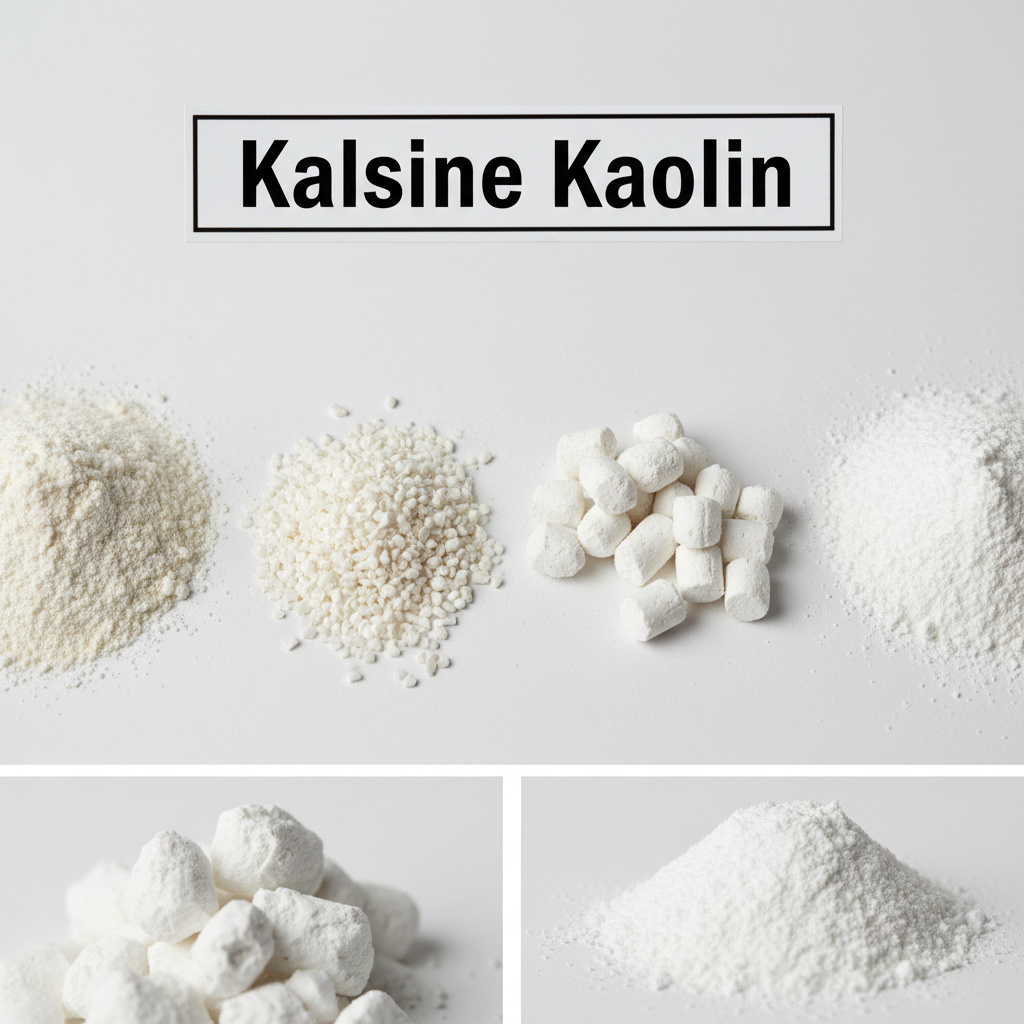
Calcined Kaolin: Properties, Production Process, Industrial Applications, and Advantages
Kaolin, a natural clay mineral, has extensive applications in the industrial world. However, calcined kaolin, obtained by subjecting kaolin to a special process at high temperatures, exhibits superior properties compared to its original form, making it an indispensable raw material in many sectors. This specialized mineral particularly stands out for its potential to improve critical performance parameters such as whiteness, hardness, and chemical inertness.
In this comprehensive article, we will delve into what calcined kaolin is, its production process, unique physical and chemical properties, broad industrial applications, and the advantages it provides. We will also touch upon Ekvator Kimya's high-quality products and solutions in this field.
What is Calcined Kaolin?
Calcined kaolin is an anhydrous aluminum silicate obtained by heating natural kaolin mineral (kaolinite) at high temperatures (typically between 500°C and 1200°C) through a thermal process called calcination. This process leads to irreversible changes in the crystal structure of kaolin and primarily occurs in two main stages:
- Dehydroxylation (Metakaolin Formation): In the approximate range of 500-900°C, hydroxyl (OH) groups in the kaolinite structure are removed as water vapor. This process disrupts the crystal structure of kaolinite, leading to the formation of an amorphous and highly reactive phase called metakaolin (Al2Si2O7). Metakaolin is particularly important in the cement and concrete industry due to its pozzolanic activity.
- High-Temperature Phase Transformations: When the temperature rises above 900°C, metakaolin begins to transform into more stable phases. Spinel-like structures form around 1000-1050°C, while above 1100°C, high-temperature minerals such as mullite (3Al2O3·2SiO2) and cristobalite occur. Industrial calcined kaolin generally refers to the product that has undergone some or all of these high-temperature phase transformations, with increased whiteness and inertness.
This thermal process fundamentally alters the chemical and physical properties of kaolin, transforming it into a material that performs superiorly to original kaolin.
Key Properties of Calcined Kaolin
Calcined kaolin, thanks to its unique properties, is an ideal filler and pigment material for many industrial applications:
1. High Whiteness and Opacity
Calcination removes organic impurities and color-imparting minerals from the kaolin structure, significantly increasing the product's whiteness. Furthermore, the particle morphology and porous structure of calcined kaolin scatter light excellently, providing high opacity (covering power). This property is critical for achieving bright and vibrant colors, especially in the paint, coating, and paper industries.
2. Increased Hardness and Abrasion Resistance
The calcination process tightens the crystal structure of kaolin and increases its density, thereby enhancing the material's hardness and abrasion resistance. This property offers an advantage in increasing the mechanical durability of products such as rubber, plastics, and ceramics.
3. Chemical Inertness
Calcined kaolin is highly chemically inert; meaning it has a low tendency to react with most chemical substances. This makes it stable even in acidic or basic environments and allows for its safe use in various chemical formulations.
4. Low Moisture Absorption and Hydrophobic Tendency
The removal of water molecules through calcination reduces the moisture absorption capacity of calcined kaolin. This property enhances product stability, especially in moisture-sensitive polymeric systems and water-based coatings.
5. Low Viscosity and Good Dispersibility
Specially processed calcined kaolin types are capable of forming suspensions with low viscosity. This allows for easy dispersion in formulations and improves processability.
6. High Insulation Properties
Calcined kaolin's low electrical conductivity and high dielectric strength make it ideal as an electrical insulation material in the cable and wire industry.
7. Thermal Stability
Thanks to its high-temperature resistant structure, calcined kaolin maintains its performance in high-temperature applications and fire retardant systems.
8. Particle Size and Morphology Control
During the production process, particle size distribution and morphology can be precisely controlled. This allows for the production of different grades of calcined kaolin to meet specific requirements of the final product, such as brightness, smoothness, rheology, and mechanical properties.
9. Oil Absorption Capacity
The oil absorption value of calcined kaolin is an important parameter, especially in the paint and coating industry, affecting the viscosity and gloss of the formulation.
Industrial Applications of Calcined Kaolin
Calcined kaolin is used as a performance-enhancing additive in a wide range of industrial applications:
1. Paint and Coating Industry
- Pigment and Filler: Due to its high whiteness and opacity, it provides cost-effectiveness by being used in place of or in conjunction with expensive pigments like TiO2.
- Matting Agent: Reduces surface gloss to achieve matte or semi-matte coatings.
- Rheology Control: Regulates the flow properties of paint, increasing sag and drip resistance.
- Corrosion Resistance: Can enhance the corrosion resistance of coatings.
2. Paper Industry
- Filler Material: Increases the whiteness, opacity, and smoothness of paper, while also reducing cost.
- Coating Pigment: Applied to the paper surface to improve print quality, ink absorption, and gloss.
3. Plastics and Rubber Industry
- Reinforcing Filler: Increases the mechanical strength, hardness, abrasion resistance, and dimensional stability of polymers.
- Electrical Insulation: Improves dielectric properties in cable and wire insulation.
- Flame Retardant Synergist: Supports performance in flame retardant systems.
- Surface Smoothness: Improves surface quality in extrusion and molding processes.
4. Ceramics Industry
- Ceramic Bodies: Increases whiteness, mechanical strength, and thermal shock resistance in porcelain, tiles, and sanitary ware products, reducing shrinkage during firing.
- Glazes: Improves the opacity and whiteness of glazes.
- Refractories: Used in the production of refractory materials for high-temperature applications.
5. Cable and Wire Industry
- Insulation Material: Enhances electrical insulation properties in polymers such as PVC, XLPE, and is used as a flame retardant additive.
6. Construction Chemicals
- Mortars and Plasters: Improves workability, strength, and durability.
- Concrete Additives: Can be used as a performance enhancer in special concrete formulations.
7. Agricultural Sector
- Pesticide and Fertilizer Carrier: Used as an inert carrier and filler in the formulations of agricultural chemicals.
8. Cosmetics and Personal Care Products
- Used as an absorbent, opacifying agent, and filler in skin care products.
Calcined Kaolin Production Process
The production of calcined kaolin involves subjecting natural kaolin to a series of processes, starting from mining:
- Mining and Beneficiation: Raw kaolin extracted from high-quality kaolin deposits is washed, ground, and sized to remove impurities.
- Drying: Beneficiated kaolin is dried to reduce its moisture content before calcination.
- Calcination: Dried kaolin is heated to high temperatures in specialized kilns such as rotary kilns or flash calciners. The temperature and residence time are adjusted according to the desired final product properties (whiteness, hardness, reactivity).
- Grinding and Classification: The calcined material is ground (micronized) to achieve the desired particle size distribution and passed through air classifiers to obtain a homogeneous product.
- Quality Control: Parameters such as whiteness, particle size, oil absorption, and chemical purity are subjected to strict quality control tests at every stage of production and in the final product.
Advantages Provided by Calcined Kaolin
Calcined kaolin offers many significant advantages in industrial applications:
- Cost-Effectiveness: Reduces formulation costs while maintaining or improving performance, especially when used in place of or in conjunction with more expensive pigments like TiO2.
- Versatility: Offers solutions for different needs across a wide industrial spectrum.
- Performance Improvement: Enhances the whiteness, opacity, hardness, abrasion resistance, chemical resistance, and electrical properties of products.
- Process Ease: Provides ease in production processes due to low viscosity and good dispersibility properties.
- Environmental Benefits: Considered an environmentally friendly alternative due to its derivation from a natural mineral and its inert nature.
Critical Factors in Calcined Kaolin Selection
When selecting the most suitable calcined kaolin for your application, it is important to consider the following factors:
- Particle Size Distribution (PSD): D50 and D90 values directly affect the brightness, smoothness, rheology, and mechanical properties of the final product.
- Whiteness and Brightness (ISO Brightness): A critical parameter, especially for optical applications.
- Oil Absorption Value: Important for viscosity and gloss control in paint and coating formulations.
- Chemical Purity: Especially iron oxide (Fe2O3) and titanium dioxide (TiO2) content are important for whiteness and chemical inertness.
- Density: Both true density and bulk density are important for formulation and storage.
- Abrasiveness: Products with low abrasiveness may be preferred, especially to minimize equipment wear.
- Surface Treatments: For some special applications, surface-treated calcined kaolins, such as those treated with silane, can provide better compatibility with polymer matrices.
Safety, Storage, and Environmental Impacts
Calcined kaolin is generally a safe industrial mineral. However, if inhaled in powder form, it can cause respiratory irritation, so appropriate personal protective equipment (mask) should be used, and work should be carried out in well-ventilated environments. The Material Safety Data Sheet (MSDS) should always be referenced.
Regarding storage, calcined kaolin should be kept in a dry and cool environment, away from direct sunlight and moisture. Keeping the packaging sealed is important to preserve the product's properties.
Since calcined kaolin is derived from a natural mineral, its environmental impact is low, and in most cases, it can be recycled or disposed of as inert waste.
Ekvator Kimya's Calcined Kaolin Solutions
As Ekvator Kimya, we are a reliable business partner in the supply of industrial chemical raw materials. Our extensive product range includes high-quality calcined kaolin varieties for different industrial needs. We provide technical expertise to offer our customers the most suitable solutions, helping them optimize the performance and cost-effectiveness of their products.
To get more information about calcined kaolin products specific to your needs, access technical documents, or request samples, please visit our calcined kaolin product page. Our expert team will be pleased to guide you in selecting the most appropriate type of calcined kaolin for your project.
Conclusion
Calcined kaolin is a critical mineral filler and pigment that enhances product performance and cost-effectiveness in many branches of modern industry. Thanks to its superior properties such as high whiteness, hardness, chemical inertness, and thermal stability, it has become an indispensable component in sectors such as paint, paper, plastics, rubber, and ceramics. As Ekvator Kimya, we contribute to our industrial customers' development of innovative and sustainable solutions by providing the highest quality calcined kaolin products.