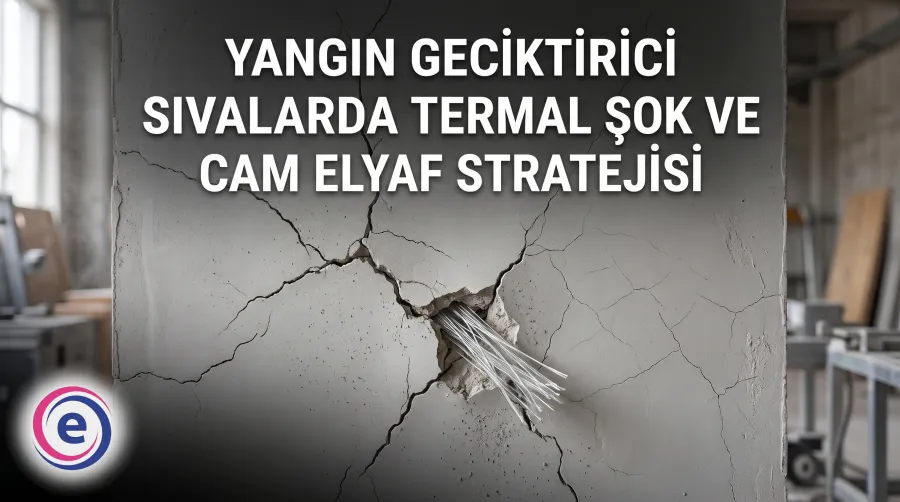
Critical Component in Passive Fire Protection: Fire Retardant Plasters
In modern construction and structural technologies, preserving the structural integrity of buildings during a fire is one of the most vital engineering objectives. Centered within passive fire protection strategies, fire retardant plasters (cement- or gypsum-based fire protective mortars) insulate steel, reinforced concrete, and timber load-bearing elements against excessive heat, thereby delaying collapse times. The fundamental purpose of these systems is to prevent temperatures reaching thousands of degrees Celsius generated during a fire from reaching structural elements and to provide the critical time window required for evacuation (e.g., R90, R120, or R180 standards). However, the greatest physical challenge these plasters face during a fire is the massive thermal shock caused by sudden temperature increases. Thermal shock can induce destructive stresses within the plaster matrix, leading to material spalling and the detachment of the protective layer. At this juncture, the innovative raw material solutions and strategies we offer to construction chemicals manufacturers as Ekvator Kimya come into play. A fire plaster that is not properly formulated will fail to maintain its physical integrity in a real fire scenario, no matter how good its insulation values are in a laboratory environment. Therefore, it is imperative to correctly integrate strategic components into the formulation—particularly glass fiber reinforcements—that will sustain the mechanical strength of the plaster matrix even at elevated temperatures.
The Phenomenon of Thermal Shock and Thermodynamics of Micro-Cracks
During a fire, the ambient temperature can rise from room temperature to 1000°C and above within minutes (varying according to cellulosic or hydrocarbon fire curves). This sudden and extreme temperature increase creates dramatic thermodynamic effects on the fire retardant plaster. In the initial phase, free water within the plaster matrix evaporates rapidly. Subsequently, as the temperature reaches the 150°C - 200°C band, the crystal water in the structure of calcium sulfate dihydrate (CaSO4·2H2O) in gypsum-based systems begins to release via an endothermic reaction. In cement-based systems, calcium silicate hydrate (C-S-H) gels dehydrate. The evaporation and expulsion of this water cause volumetric shrinkage of the mortar. When volumetric shrinkage occurs at different rates in different regions of the material, internal tensile stresses arise. By nature, the plaster matrix is a material resistant to compression but relatively weak against tension. When these high tensile stresses exceed the strength limit of the material, micro-cracks begin to form. In the later stages of the fire, these micro-cracks coalesce into macro-cracks, causing the transmission of flames, the formation of thermal bridges, and ultimately the delamination of the plaster from the load-bearing surface. To compensate for this destructive effect created by thermal shock, it is essential to incorporate a reinforcement system into the matrix that will counteract tensile stresses, withstand high temperatures without melting, and maintain dimensional stability. At this point, glass fiber reinforcement emerges as an indispensable fire-resistant mortar additive element in passive fire protection.
Mechanical Bridging Effect of Glass Fiber
Glass Fiber serves as an ideal micro-reinforcement material for fire retardant plasters due to its inorganic structure, high tensile strength, and high softening/melting point between 800°C and 1000°C (E-Glass or AR-Glass, depending on the glass type used). The primary function of glass fiber within the plaster matrix is not entirely to prevent crack formation, but rather to halt the propagation of generated micro-cracks and establish a mechanical bridging effect between crack surfaces. When thermal shrinkage-induced stresses initiate a crack within the matrix, the crack encounters homogeneously distributed glass fiber filaments as it propagates through the matrix. The glass fiber connects the two sides of the crack, absorbing the stress onto itself and distributing it to wider areas of the matrix. This mechanism prevents the crack from reaching a critical size and the material from disintegrating. Even if the binder matrix (cement or gypsum) largely loses its structural integrity during a fire, the material continues to hold together and perform its insulating function thanks to the glass fiber network. However, the successful operation of this protective network depends directly on the distribution homogeneity of the fiber within the matrix, the strength of the interface bond formed by the fiber with the matrix, and, most importantly, the geometric properties (length and diameter) of the fiber preferred in the formulation.
Optimum Fiber Length Selection: 3mm, 6mm, and 12mm Strategies
In fire retardant plaster formulations, the performance of glass fiber depends largely on the fiber length and its dosage rate in the formulation. As Ekvator Kimya, within the scope of our construction raw materials solutions, we develop fiber strategies in different cut lengths tailored to the specific needs of manufacturers.
- 3mm Glass Fiber: Short-cut fibers provide a very high number of fibers within the matrix and exhibit exceptional homogeneous distribution. Due to their short length, they have a minimal effect on the rheology and workability of the mortar. They do not cause nozzle clogging in spray applications. However, due to their short length, their mechanical bridging effect is limited. They are generally preferred in low-thickness intumescent coatings or thin-layer fire plasters to prevent surface micro-cracks.
- 6mm Glass Fiber: Accepted as the industry standard, 6mm fibers offer an excellent balance between workability and mechanical performance. By forming a moderate network structure, they provide strong resistance against thermal shocks during a fire. They are highly effective in preventing macro-cracks in thick cement-based fire plasters. They are compatible with pumping and spraying systems, and do not cause balling when supported with correct rheological additives.
- 12mm Glass Fiber: Long-cut fibers offer maximum tensile strength and the strongest bridging effect. They are mandatory for heavy-duty fire plasters used in heavy industrial facilities, tunnels, and petrochemical plants carrying hydrocarbon fire risks. Long fibers can hold even large cracks together. However, the integration of 12mm fibers into the formulation requires serious engineering. They dramatically increase the viscosity of the mortar and are prone to agglomeration during incorrect mixing processes. The use of these fibers must be rheologically balanced with special superplasticizer and cellulose ether combinations.
Mortar Workability, Rheological Balancing, and Interface Interaction
Although the fire performance-enhancing effect of glass fiber is indisputable, the addition of this raw material to plaster formulations complicates the fresh-state properties (rheology) of the mortar. Fibers increase water demand and alter the thixotropic structure of the mortar. Particularly in spray-applied fireproofing, it is critically important that the fiber does not jam inside the pump, cause pressure loss in hoses, and exits the gun homogeneously during spraying. 'Balling', the biggest problem encountered when high proportions or long fibers are used, occurs when fibers intertwine to form clumps instead of dispersing within the mortar. This causes some areas of the material to be fiber-free (weak) and others to be over-fibered (unworkable). To overcome these rheological problems, formulators must optimize water-retention agents (cellulose ethers), air entrainers, and specialized plasticizers. Furthermore, glass fibers to be used in cement-based high-alkali environments must necessarily be Alkali-Resistant (AR) zirconium-doped. While E-Glass types can be safely used in gypsum-based neutral systems, they suffer alkaline corrosion over time in a cement matrix and lose their mechanical properties. The strength of the interface bond between the matrix and the fiber determines the efficiency of stress transfer during a fire; an overly weak bond leads to fiber pull-out, while an overly strong bond leads to fiber breakage. An ideal formulation includes an interface design that allows the fiber to pull out to a certain extent, thereby dissipating energy.
Fire Standards (EN 13381 and UL 263) and Certification Processes
Passive fire insulation products are subjected to the world's most stringent test standards before being marketed. The EN 13381 series in Europe and UL 263 (ASTM E119) standards in America are the primary references used to evaluate the fire protection of structural elements. During these tests, plastered steel or concrete specimens are exposed to standard fire curves (ISO 834) or much more aggressive hydrocarbon fire curves in special furnaces. The success of the test depends not only on how well the material insulates heat, but also on whether the plaster stays in place (adhesion and cohesion) under severe turbulence, thermal shock, and structural deformations inside the furnace. A plaster that cannot withstand thermal shock and cracks and detaches in the early stage will fail the test, no matter how low its insulation coefficient is. At this critical threshold, the correct glass fiber strategy integrated into the formulation is the greatest guarantee of passing the test. Under the ruthless conditions of the furnace, the fibers form the skeleton of the plaster, preventing detachment and guaranteeing the R (Resistance) duration promised by the material (e.g., steel temperature not exceeding 500°C for 120 minutes). For manufacturers, these certification processes are extremely costly and time-consuming; therefore, there is no margin for error during the formulation development stage.
Technical Solution Partnership with Ekvator Kimya
The production of fire retardant plasters is a specific field of expertise that requires advanced materials science and a deep understanding of thermodynamics, beyond ordinary construction chemical production. Success comes not just from combining raw materials, but from anticipating how these raw materials will create synergy under extreme conditions. As Ekvator Kimya, we stand by our business partners not only with our broad product portfolio, but also with our sectoral know-how and R&D support. We help you design the correct binder, additive, and fiber combinations to maximize thermal shock resistance in your formulations, permanently solve micro-crack problems, and seamlessly meet international fire standards (EN, UL). To obtain detailed information about project-specific glass fiber profile selection, rheological balancing, and formulation optimization, to review our solutions within the product list, or to request technical consultancy, you can contact our expert engineering staff and technical service. Do not leave safety to chance in passive fire protection; create life-saving formulations with the right raw material strategy.