
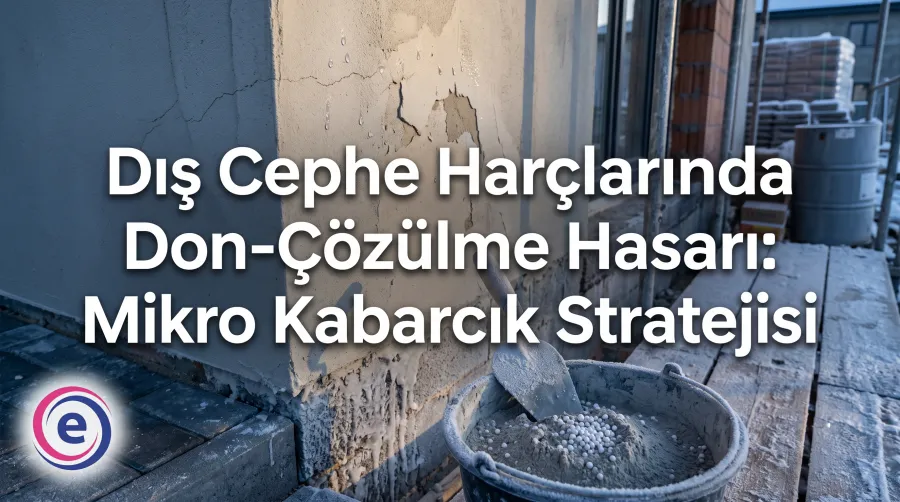
Introduction: Climatic Challenges in Exterior Facade Mortars and Freeze-Thaw Risks
Construction chemicals used in outdoor applications, particularly exterior repair mortars, thermal insulation plasters, and outdoor screeds, are exposed to a wide variety of environmental stress factors throughout their service lives. One of the most destructive of these factors is freeze-thaw cycles caused by the phase change of water. Particularly in geographies dominated by continental climates with high day-and-night temperature differentials, the freezing and expansion of water infiltrating the capillary voids of cementitious systems create the basis for micro-cracks to form in the internal structure of the material. As a result of recurring cycles, these micro-cracks lead to macro-level structural damages, scaling, delamination, and ultimately the complete detachment of the mortar from the load-bearing substrate.
In the modern construction chemicals industry, preventing this degradation is not possible merely by increasing the binder dosage or decreasing the water/cement (W/C) ratio. Because even in high-performance mortars with the lowest W/C ratio, an inevitable network of gel and capillary voids is formed as a result of cement hydration. At this point, the most definitive and innovative solution for R&D managers and formulators is to integrate a controlled, stable, and homogeneously distributed micro-bubble network into the mortar matrix. Specific surfactants in our construction raw materials portfolio form the fundamental building blocks of this strategy.
Thermodynamics and Damage Mechanism of the Freeze-Thaw Cycle
To understand the vulnerability of an exterior facade mortar to freeze-thaw cycles, it is necessary to examine the thermodynamic behavior of water within the cementitious matrix. When pure water freezes at 0°C, its volume increases by approximately 9%. However, pore water inside a cementitious matrix has a lower freezing point due to the dissolved alkalis and salts it contains. When the temperature drops below zero, water in the largest capillary voids begins to freeze first. The volumetric expansion released during this phase change pushes the unfrozen water toward smaller capillary voids, creating massive hydraulic pressure.
Capillary Voids and Expansion Pressure of Ice Crystals
According to the Hydraulic Pressure Theory proposed by T.C. Powers, the expansion generated by freezing water forces the water to migrate along capillaries. If the frictional resistance encountered by this water during movement exceeds the tensile strength of the mortar, irreversible cracks are formed within the matrix. In addition, as ice crystals grow, they create osmotic pressure by drawing water from surrounding gel pores. Especially in outdoor screeds where de-icing salts are used during winter months, this osmotic pressure reaches much more severe levels. The fundamental basis of scaling complaints encountered by manufacturers lies in this high osmotic potential and thermal shock created by salts accumulating on the surface.
Micro-Bubble Strategy: The Critical Role of Air Entraining Agents (AEA)
The most rational way to prevent hydraulic and osmotic pressure from disrupting the mortar matrix is to create micro-expansion chambers where freezing water can expand and excess pressure can be dissipated. At this juncture, incorporating air entraining agents (AEAs) into the formulation is a critical engineering move. Air entrainers are surfactants that stabilize the air introduced into the medium during mortar mixing by reducing surface tension and forming spherical micro-bubbles with a diameter of 10 to 300 micrometers within the matrix.
Unlike capillary voids, these micro-bubbles do not fill with water. This is because their inner surfaces are coated by the hydrophobic tails of the air-entraining molecules, preventing water ingress into the bubbles. The hydraulic pressure generated during the freezing of water pushes the water toward these micro-bubbles. When the water enters the bubble, it finds free volume to expand, keeping the internal stresses of the mortar well below the critical tensile strength limit.
Importance of Correct Bubble Size and Distribution (Spacing Factor)
Simply trapping air inside the mortar does not guarantee freeze-thaw resistance. Randomly formed entrapped macro-air voids do not function in pressure dissipation and seriously reduce the mechanical strength of the mortar. For effective protection, two critical parameters must be met: Specific Surface Area and Spacing Factor.
- Spacing Factor (L): It is the maximum distance from any point in the cement paste to the periphery of the nearest air bubble. For freeze-thaw resistance, this value is generally desired to be less than 0.20 mm (200 micrometers). When this distance is exceeded, hydraulic pressure shatters the matrix before the displaced water can reach the bubble.
- Specific Surface Area (Alpha): It is the total surface area of air bubbles per unit volume. A value greater than 25 mm⁻¹ is an indicator that the bubbles are sufficiently small and densely distributed.
Chemical Typology and Rheological Compatibility of Air Entraining Agents
In polymer-modified cementitious systems such as exterior facade mortars and outdoor screeds (dry-mix mortars), the selection of the air-entraining agent to be used directly affects the overall rheology of the formulation. As Ekvator Kimya, while offering R&D managers a characteristic raw material vision beyond formulation, we analyze entrainers of different chemical structures compatible with binder systems.
Sulphonate-Based Air Entrainers
Alkyl benzene sulphonates and similar anionic surfactants are traditional air entrainers that have been used in the construction chemicals industry for many years. The sulphonate group interacts strongly with calcium ions on the surface of cement particles. This interaction ensures the adsorption of the surfactant onto cement particles and renders the particle surface partially hydrophobic. This facilitates the adhesion of air bubbles to cement particles during mixing. However, sulphonate-based products can be sensitive to the amount of free calcium in the system (water hardness). Furthermore, when used with high dosages of polycarboxylate ether (PCE)-based new-generation superplasticizers, they may create competitive adsorption on the cement surface, slightly suppressing the performance of the superplasticizer.
Olefin-Based Air Entrainers
Alpha-olefin sulphonates (AOS) and modified olefin derivatives are more advanced air entrainers that have stood out in high-performance mortar formulations in recent years. The primary advantage of olefin-based agents is that the elasticity and stability of the bubble film they form are significantly higher. These agents exhibit excellent tolerance against water-hardening ions. The micro-bubble network obtained with olefin-based entrainers is less affected by mixing time or mechanical stress during mortar pumping. Air loss during spray application in outdoor screeds is a major problem. Olefin-based systems maintain bubble stability even under pump pressure due to steric repulsion and strong micelle structures, providing reliable freeze-thaw resistance on the job site.
Synergistic Interactions with Cement and Binder Systems
Exterior repair mortars generally do not contain Portland cement (CEM I) alone; they are formulated with pozzolanic mineral additions such as fly ash, slag, silica fume, and special binders such as calcium aluminate cement (CAC). Particularly high-carbon fly ashes can physically adsorb air-entraining agents and reduce their effectiveness. In such complex binder systems, optimizing the surfactant dosage is essential to achieve the targeted 15-20% micro-air volume.
Additionally, cellulose ethers (HPMC, HEMC) and redispersible polymer powders (RDP) within the mortar also tend to entrain air into the medium on their own. However, the air entrained by these polymers typically consists of coarse, irregular, and unstable macro-voids. An R&D engineer designing true freeze-thaw resistance must eliminate this polymer-induced undesired macro-air from the system by adding a suitable powdered defoamer to the formulation, while simultaneously re-establishing the micro-bubble network of only the desired size by introducing a special air entrainer into the system.
Formulation Optimization and Quality Control for R&D Managers
For R&D laboratories aiming to develop durable, long-lasting exterior facade mortars or outdoor screeds resistant to harsh climatic conditions, freeze-thaw resistance additives must be meticulously selected. The following steps should be followed in formulation optimization:
- Determination of Rheological Targets: The desired consistency (thixotropic repair mortar or self-leveling screed) dictates the type of air entrainer. While the risk of bubbles rising and surfacing is low in thixotropic mortars, this risk is high in fluid screeds; therefore, olefin-based entrainers with high stability should be preferred in fluid systems.
- Cement-Additive Compatibility Tests: The compatibility of the selected AEA with the PCE superplasticizer and cellulosic thickener in the formulation should be analyzed through zeta potential and viscosity.
- Fresh Mortar Analysis: Air content (via the pressure method) and bulk density measurements must be standardized. The targeted air content should be between 4% and 8% (by volume).
- Hardened Mortar Analysis: Spacing Factor determination should be performed using microscopic petrography methods, and freeze-thaw cycle tests conforming to standards such as ASTM C666 should be conducted.
Innovation and Sustainability in Construction Raw Materials with Ekvator Kimya
As Ekvator Kimya, with our deep-rooted know-how in the industrial chemistry sector, we offer innovative raw material solutions to the most challenging technical problems faced by construction chemicals manufacturers. Minimizing customer complaints arising from freeze-thaw in exterior facade systems will directly enhance the reliability and brand value of your products in the market. We accelerate your R&D processes with high-performance, stability-guaranteed air-entraining agents and other specific construction chemical additives that we supply. Our technical team is ready to provide engineering support to manufacturers regarding the selection of surfactants most suitable for your formulation and dosage optimization.
Conclusion
Freeze-thaw damage in exterior facade mortars and outdoor screeds is a thermodynamic reality that pushes the physical limits of the material. However, a micro-bubble network to be built into the cement matrix with the correct chemical agents is the ultimate defense line capable of completely dissipating the destructive expansion pressure of ice crystals. Understanding the molecular-level behaviors of sulphonate- and olefin-based air-entraining agents and aligning them with the rheology of the binder system transforms a standard mortar into a high-performance engineering product. To discover technical-depth raw materials in your new-generation mortar designs, request samples, and secure your projects, you can contact our expert team immediately and benefit from Ekvator Kimya's robust supply network.


